
What Is It With Jews? Questions We’re Not Allowed to Ask
The Forbidden Inquiry
Most people today believe that being called “antisemitic” is a modern defense mechanism rooted in the horrors of the Holocaust. Christians have reinforced this belief by accepting the premise that Jews are “God’s chosen people” based on biblical texts. But honest inquiry into history, etymology, and theology reveals problems with the standard narrative—problems that are immediately shut down by accusations of “antisemitism” the moment they’re raised.
This article explores questions that are rarely asked and seldom answered: What does “antisemitism” actually mean? Who are “the Jews”? Can anyone prove descent from ancient Judah? And why is challenging historical or political narratives conflated with religious hatred?
The Origin of “Antisemitism” – A Pseudo-Scientific Racial Term
The term “antisemitism” first appeared in Germany in 1879, coined by Wilhelm Marr. Marr was seeking to give a “scientific” veneer to Jew-hatred by framing it as racial opposition rather than religious prejudice. The term was created well before Hitler was born, and while most people alive today believe its origins to begin there, it was not. It was not a response to the Holocaust but a 19th-century pseudo-scientific racial construct.
Marr wanted to replace the German word “Judenhass” (Jew-hatred) with something that sounded more respectable and academic. He founded the “Antisemiten-Liga” (League of Antisemites) and promoted the term as part of a racial ideology that classified Jews as a separate “Semitic race” in opposition to “Aryans.”
The irony: “Semitic” is a linguistic category (Hebrew, Arabic, Aramaic), not a race. Arabs are also Semitic peoples, but “antisemitism” has only ever meant hatred of Jews.
How Is “Antisemitism” Used Today?
When you hear the term “antisemitism” used in modern discourse, is it ever in a religious context? If you’re honest, you’ll realize the answer is almost always no.
When have you witnessed:
- A theological debate between a Jew and a Christian labeled “antisemitism”?
- A Jew and a Muslim discussing religious differences and being called antisemitic?
- Religious persecution of Jews for practicing Judaism in Western countries?
The term is thrown around constantly, yet it rarely has anything to do with religion.
How is “antisemitism” actually used today:
- Criticism of Israeli government policies
- Questioning the financial or political influence of certain groups
- Challenging historical narratives
- Questioning Zionism or the founding of Israel
- Noticing demographic patterns in specific industries or institutions
- Sometimes, just disagreeing with anyone who happens to be Jewish
The tactic:
- Label the person an “antisemite.”
- Force them to defend against the charge instead of continuing their line of questions.
- Ignore the original question and focus instead on their newly assigned label.
- Refuse to engage further with an “antisemite.”
This is intellectual dishonesty, not legitimate protection of a religious minority.
Who or what is Israel?
The biblical narrative contains a fundamental chronological problem that raises serious questions about when these texts were actually written—and whether “Israelite” ever had a clear, consistent meaning.
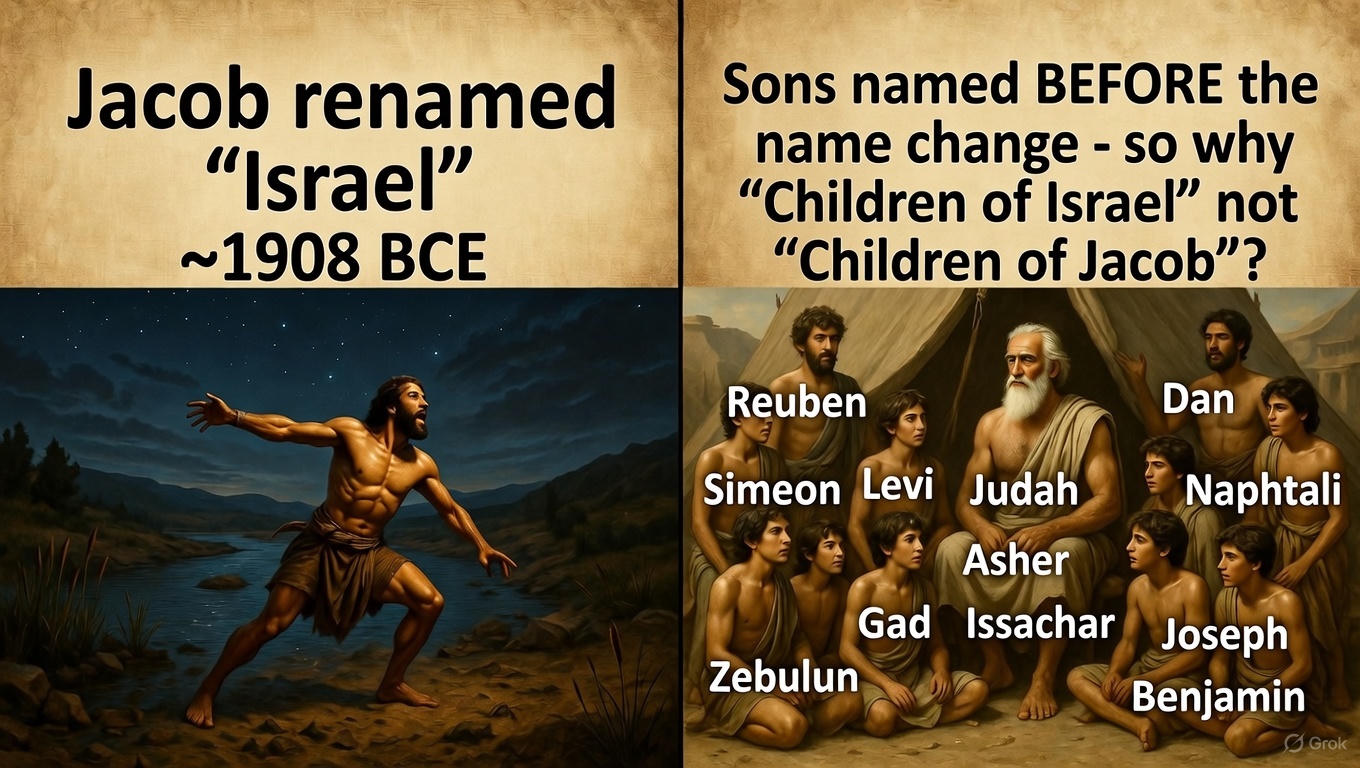
Jacob Renamed “Israel” – But Why?
Genesis 32:28 records the name change:
“Then the man said, ‘Your name will no longer be Jacob, but Israel, because you have struggled with God and with humans and have overcome.’”
- When did this happen? Around 1908 BC, while Jacob was still alive
- Why was he renamed? The Bible offers only a cryptic explanation about “struggling with God.”
- What does “Israel” mean? Scholars debate: possibly “struggles with God” or “God prevails.”
- Did anything change? The Bible continues calling him “Jacob” and “Israel” interchangeably (Genesis 46:2 – God calls him both names in the same conversation)
At this point, “Israel” is just one man. His twelve sons—Reuben, Simeon, Levi, Judah, Dan, Naphtali, Gad, Asher, Issachar, Zebulun, Joseph, Benjamin—were all born and named before or around the time of this name change. None of them is called “sons of Israel” individually; they keep their own names.
The Immediate Shift to Political Language
Here’s where it gets suspicious: Almost immediately after Jacob’s name change, the Bible starts using political and national terminology to describe his descendants—even though no nation or political entity called “Israel” existed.
Genesis 46:8 (Jacob’s family entering Egypt, c. 1876 BC):
“These are the names of the sons of Israel [note: called “Israel” not “Jacob”] who came to Egypt, Jacob and his descendants…”
This is a family of 70 people. Yet they’re called “the sons of Israel” collectively.
Exodus 1:7-9 (400 years later, still in Egypt):
“But the Israelites were exceedingly fruitful; they multiplied greatly, increased in numbers, and became so numerous that the land was filled with them. Then a new king, to whom Joseph meant nothing, came to power in Egypt. ‘Look,’ he said to his people, ‘the Israelites have become far too numerous for us.’”
Now they’re called “the Israelites” – a national/ethnic designation.
Exodus 3:9-10 (God speaking to Moses):
“And now the cry of the Israelites has reached me, and I have seen the way the Egyptians are oppressing them. So now, go. I am sending you to Pharaoh to bring my people the Israelites*out of Egypt.”
Exodus 19:3 (At Mount Sinai, the covenant):
“Then Moses went up to God, and the LORD called to him from the mountain and said, ‘This is what you are to say to the descendants of Jacob and what you are to tell the people of Israel…’”
Notice the language:
- ”The people of Israel” – This is political/national terminology
- ”The Israelites” – This implies a distinct nation/people
- ”Elders of Israel” (Exodus 3:16, 12:21, 19:7) – Political leadership structure
The Problem: No Country Called “Israel” Existed.
Here’s the chronological claims from the Bible:
- Jacob renamed “Israel” — c. 1908 BC — One man
- Jacob’s family enters Egypt (70 people) — c. 1876 BC — NO country exists
- Exodus from Egypt — c. 1446 BC — NO country exists
- Sinai Covenant with “Israelites” — c. 1446 BC — NO country exists
- Conquest of Canaan under Joshua — c. 1406 BC — NO country exists (12 tribes settling land)
- Period of Judges — c. 1200-1050 BC — NO country exists (tribal confederation)
- Kingdom of Israel formed under King Saul — c. 1050 BC — FIRST TIME a political entity “Israel” exists
The covenant at Sinai was made approximately 400 years before the nation-state “Israel” was formed.
Consider comparable examples:
- The Bible doesn’t call Abraham’s descendants “the people of Abraham” or “the elders of Abraham.”
- The Bible doesn’t call Isaac’s descendants “the people of Isaac” or “the nation of Isaac.”
- The Bible doesn’t see “the people of Jacob” used before Jacob’s name was changed to Israel
But immediately after one man is renamed “Israel,” the Bible starts using national/political language (”people of Israel,” “elders of Israel,” “the Israelites”) as if describing citizens of a country, not descendants of a man.
This strongly suggests these texts were written well after the Kingdom of Israel was established (post-1050 BC), by authors who used the political terminology of their own time and projected it backward onto events that occurred centuries earlier.
It would be like finding a document about Jamestown colonists in 1607 that refers to them as “the American people” and “the elders of America”—terms that wouldn’t exist until 1776. This would provide immediate proof of the document’s authenticity if it referred to events that happened later.
Who Exactly Was an “Israelite”?
The Bible never clearly defines this. The term shifts meaning:
Northern Tribes of Israel
II Kings 17:13 “Yet the LORD testified against Israel, and against Judah, by all the prophets, and by all the seers, saying, Turn you from your evil ways, and keep my commandments and my statutes, according to all the law which I commanded your fathers, and which I sent to you by my servants the prophets.“
II Kings 17:15 “And they rejected his statutes, and his covenant that he made with their fathers, and his testimonies which he testified against them; and they followed vanity, and became vain, and went after the heathen that were round about them, concerning whom the LORD had charged them, that they should not do like them.“
II Kings 17:16 “And they left all the commandments of the LORD their God, and made them molten images, even two calves, and made a grove, and worshipped all the host of heaven, and served Baal.“
II Kings 17:18 “Therefore the LORD was very angry with Israel, and removed them out of his sight: there was none left but the tribe of Judah only.“
At this point in the story, the 10 Northern tribes no longer exist, and only Judah remains. But it doesn’t stop there; it goes on to describe what was going on in Judah as well. It is also worth noting that Israel represented only the 10 Northern tribes, not Judah. Also worth noting is that our terms above referred to “From Judah” to represent the people from there, not specifically the chosen people, and more specifically, not all of the chosen people.
Southern Tribes of Judah
II Kings 17:19 “Also Judah kept not the commandments of the LORD their God, but walked in the statutes of Israel which they made.“
II Kings 17:20 “And the LORD rejected all the seed of Israel, and afflicted them, and delivered them into the hand of spoilers, until he had cast them out of his sight.“
II Kings 17:21 “For he rent Israel from the house of David; and they made Jeroboam the son of Nebat king: and Jeroboam drove Israel from following the LORD, and made them sin a great sin.“
II Kings 17:22 “For the children of Israel walked in all the sins of Jeroboam which he did; they departed not from them;“
II Kings 17:23 “Until the LORD removed Israel out of his sight, as he had said by all his servants the prophets. So was Israel carried away out of their own land to Assyria to this day.“
This gets a bit confusing because we first saw a separation between Israel and Judah, and we then started the next section with Judah. However, it seems to switch back to Israel for no reason, and we’re left wondering to which group it is discussing. I would suggest it is safe to say this section is about Judah, though, and it is also worth noting that “to this day” suggests they have not returned. Also, they are guilty of the same crimes against God as the Northern tribes, so what would cause one group to be allowed back while the other group remains departed?
II Kings 17: 29 “However, every nation made gods of their own, and put them in the houses of the high places which the Samaritans had made, every nation in their cities wherein they dwelled.“
II Kings 17:33 “They feared the LORD, and served their own gods, after the manner of the nations whom they carried away from there.”
So the people of Samaria were afraid of the Lord but continued to worship their own gods.
II Kings 17:34 “To this day they do after the former manners: they fear not the LORD, neither do they after their statutes, or after their ordinances, or after the law and commandment which the LORD commanded the children of Jacob, whom he named Israel;“
II Kings 17:40 “However, they did not listen, but they did after their former manner.“
II Kings 17:41 “So these nations feared the LORD, and served their graven images, both their children, and their children’s children: as did their fathers, so do they to this day.“
Then later, in II Kings 24 and 25, we get more details of the actual events that took place when Judah fell.
II Kings 25:9 “And he burnt the house of the Lord, and the king’s house, and all the houses of Jerusalem, and every great man’s house burnt he with fire.“
II Chronicles 36:19 “And they burnt the house of God, and brake down the wall of Jerusalem, and burnt all the palaces thereof with fire, and destroyed all the goodly vessels thereof.“
Ezra 2:59 “And these were they which went up from Tel–melah, Tel–harsa, Cherub, Addan, and Immer: but they could not shew their father’s house, and their seed, whether they were of Israel:“
It is curious how it says everything was burned, and yet only certain families were unable to prove their bloodline.
The Judah-Only Problem
After the Assyrian conquest (722 BCE), only the Southern Kingdom survived—but only for 136 more years.
The Northern Kingdom fell first (722 BCE):
- 10 tribes conquered by Assyria
- Judah (the tribe), Benjamin (a small tribe), and the Levites (priests) remained independent in the south
2 Kings 17:6-23 describes the northern tribes’ fate:
“The king of Assyria invaded the entire land, marched against Samaria and laid siege to it for three years. In the ninth year of Hoshea, the king of Assyria captured Samaria and deported the Israelites to Assyria…All this took place because the Israelites had sinned against the LORD their God…they worshiped other gods…The LORD rejected all the people of Israel; he afflicted them and gave them into the hands of plunderers, until he thrust them from his presence…So the people of Israel were taken from their homeland into exile in Assyria, and they are still there.”
What happened to the ten tribes?
- Scattered throughout the Assyrian empire
- Intermarried with foreign populations
- Adopted foreign gods and customs
- Lost their distinct identity as “Israelites.”
But they still had Abraham’s bloodline. If being “chosen” is about genetics, they should still be chosen. This proves that “Israelite” or “chosen” status was NOT primarily about bloodlines—it was about maintaining the covenant and cultural identity.
The Bloodline Purity Problem
If “Jewish” means “descended from Judah,” consider the logical problems:
- Who was actually from Judah?
- After the Babylonian exile (586 BCE), how do you prove that your ancestors were specifically from Judah?
- No genealogical records existed. 2 Kings 25:8-9: The Temple was burned down in 586 BCE, “And he burnt the house of the LORD, and the king’s house, and all the houses of Jerusalem, and every great man’s house burnt he with fire.
- Ezra 2:59-63: 50 years later, people can’t prove ancestry and can’t find records
- Jerusalem was destroyed multiple times
- Populations were scattered and mixed
- The intermarriage problem:
- If anyone in your ancestral line married a non-Jew, does that “cancel out” the bloodline? It was a contributing factor in the 10 northern tribes losing theirs, apparently.
- After 2,500+ years, how many “pure” bloodlines could exist?
- The books of Ezra and Nehemiah show that intermarriage was common even among returning exiles
- Ezra 9-10 records that Jewish men married foreign women, and Ezra forced them to divorce
- The inbreeding problem:
- If the bloodline must remain “pure” (only Judeans marrying Judeans), then the entire population would have to be endogamous (inbreeding)
- Is the claim that Jews maintained complete genetic isolation for 2,500+ years?
- This is biologically implausible and genetically unsustainable
- Modern genetic studies show Jewish populations did intermarry with local populations wherever they settled
- Converts destroy the bloodline argument:
- Judaism accepts converts who have zero Abrahamic ancestry
- Their children are considered fully Jewish
- This proves bloodline is NOT the defining criterion
- If a convert with no Israelite blood is “Jewish,” then being Jewish is religious/cultural, not genetic
The Unanswerable Question
The Bible provides no clear, consistent answer to: “Who is an Israelite?” or “Who is a Jew?” or “What does Israel even represent?”
- Bloodline from Jacob/Israel? Then the ten tribes are still chosen (same DNA), but the Bible says they’re lost.
- Covenant keepers? Then secular Jews aren’t Jewish, and converts are—but this contradicts ethnic claims.
- Citizens of a kingdom? That kingdom hasn’t existed since 722 BCE (north) or 586 BCE (south).
- Descendants of Judah specifically? Unprovable after 2,500 years, multiple dispersions, destroyed records, and intermarriage.
The definitions are contradictory. The bloodline claims are unfalsifiable. And the Bible itself is inconsistent about what “Israel”, “Israelite”, or “Jew” actually means.
This fundamental ambiguity makes the claim “Jews are God’s chosen people” impossible to verify or falsify. Chosen based on what? A Bloodline that can’t be proven? Covenant observance that most don’t maintain? Citizenship in a kingdom that hasn’t existed for 2,600 years? Descent from Judah that’s impossible to trace? Even with the advances in computer technology today, very few of us can trace our ancestry back more than 300-400 years. Yet, Jews seem capable of tracing their history back over 2500 years with no documentation to support it.
The fact is, the Bible doesn’t clearly explain any of this, and that should concern anyone making definitive claims about who is or isn’t “chosen.”
Who Are “The Jews”?
The term “Jew” itself raises questions that deserve further examination.
The Etymology of “Jew”
- The word “Jew” does not appear in the original biblical texts.
- Hebrew (Old Testament): Yehudi (יְהוּדִי) – “of Judah”
- Greek (New Testament/Septuagint): Ioudaios (Ἰουδαῖος)
- Latin (Vulgate): Iudaeus
The English word “Jew” evolved through many spellings:
- Old French:** Juiu, Giu
- Middle English (12th-15th centuries): Giu, Giw, Iuu, Iuw, Iu, Iwe, Iewe, Ieuu
- Early Modern English (16th-17th centuries): Iewe, Iew
- Modern English (17th-18th century onward): Jew
The modern spelling “Jew” is only a few hundred years old. The original biblical term was Yehudi – meaning “of Judah” or “from Judah.”
The Twelve Tribes and the Kingdom Split
The background:
- Twelve tribes of Israel descended from Jacob’s twelve sons
- Judah was one of these tribes
- Around 1050 BCE, all tribes united under Kings Saul, David, and Solomon
- Capital: Jerusalem (in Judah’s territory)
- In 930 BCE, after Solomon’s death, the kingdom split into two:
Northern Kingdom (”Israel”):
- 10 tribes led by Ephraim/Manasseh
- Capital: Samaria
- Conquered by Assyria in 722 BCE
- The 10 tribes scattered/assimilated (”Lost Tribes”)
Southern Kingdom (”Judah”):
- 2 main tribes: Judah + Benjamin (plus Levites)
- Capital: Jerusalem
- Conquered by Babylon in 586 BCE
- Unlike the northern tribes, Judah’s people survived exile
After the Babylonian exile, only the people from the Kingdom of Judah remained as a distinct group. ”Yehudi” (of Judah) became the term for all surviving Israelites and eventually became what we know today as “Jew.”
So “Jew” originally meant:** A person from Judah – a geographical and tribal designation, not necessarily a religious identity.
The Cyrus Cylinder and the Dubious Return from Exile
The biblical account (Book of Ezra) claims that Persian King Cyrus the Great issued a decree in 538 BCE allowing Jews to return to Jerusalem and rebuild the Temple. There are several problems with this claim, though. The most obvious being that of a king caring about a tiny percentage of his newly acquired people being allowed to resettle their original homeland. Not to mention, caring about whether they move back into the area. There is no real incentive either way on this matter, although their moving back did seem to cause problems with the Samaritans who also lived in the area, according to Ezra/Nehemiah.
Another problem arises out of the fact that the Cyrus Cylinder—the famous archaeological artifact often cited as “confirming” this decree—does not mention Jews, Jerusalem, Israel, or Judea and contains no such decree. It does include information on the restoration of Babylonian sanctuaries, the return of people within Babylonia (Mesopotamia), and Cyrus’s general policy of restoring local cults in Mesopotamia.
Biblical historian Bob Becking concludes: ”It has nothing to do with Judeans, Jews or Jerusalem.”
The most likely explanation: Some Jews gradually returned under a general Persian policy of tolerance, faced local opposition, and struggled for decades. Later biblical writers attributed this to a grand “Decree of Cyrus” to give it divine significance. The only source for this decree is the Bible itself.
If you were to imagine a small group of people arriving in town and declaring that they were the rightful owners of the land because their God declared it so, it might cause some serious contention with the neighbors.
Christians and the Chosen People?
Christians often claim “Jews are God’s chosen people,” without considering where this originates, where in the Bible it says this, or what it even means. Who qualifies as a descendant of Jacob, and how would you know if they really were? There are no birth records, no comprehensive family records, and Jerusalem was destroyed multiple times; if there were any records, they were destroyed, not to mention people changing their names to better their positions in society.
So current-day Jews declaring themselves as “God’s chosen people” are claiming a title without knowledge or proof that they actually are that thing. It seems odd that God would even use this to keep track of his favorite children. No one can prove descent from Abraham, Isaac, Jacob, or David. The claim is unfalsifiable and therefore scientifically meaningless.
The problem gets worse when you consider that only Judah remained. The term “Jew” literally means “from Judah”—not from Reuben, Dan, Ephraim, or any of the other tribes. According to 2 Kings 17:6-23, the ten northern tribes were conquered by Assyria in 722 BCE, scattered throughout the empire, intermarried with foreigners, and worshiped other gods, becoming the Samaritans (whom Jews later despised as racially and religiously impure). It should also be remembered that “Israel”, other than being a new name for Jacob, also represented, for a short time, the combining of the 12 tribes, and that Jerusalem was the capital and was in Judah. What this really means is that the current-day “Israel” is a new political organization, not the original country of Israel.
If being “chosen” is based on bloodline/DNA, then the ten tribes are still chosen—they still have Abraham’s DNA. Assimilation doesn’t change genetics. Marrying an Assyrian doesn’t alter your chromosomes. Worshipping Baal doesn’t delete your ancestry. But if the ten tribes lost their “chosen” status through assimilation and covenant-breaking, then being “chosen” was NEVER about bloodline. It was about keeping the covenant—following Torah, worshiping YHWH, maintaining the law.
And this brings another insurmountable problem: Even if someone wanted to keep the Mosaic covenant today, they cannot. The covenant required:
- Animal sacrifices at the Temple (Leviticus 1-7)
- A functioning priesthood (descendants of Aaron)
- The Temple in Jerusalem (destroyed 70 CE, never rebuilt)
Without the Temple, there can be no sacrifices. Without sacrifices, there can be no atonement under the old covenant. Without atonement, the covenant cannot be kept. So even the most religious, Torah-observant Jew today cannot fulfill the requirements of the Mosaic covenant. The system is broken and has been for nearly 2,000 years. If being “chosen” required keeping the covenant, and the covenant can no longer be kept, then no one is “chosen” under the old system—regardless of ancestry.
The Bible’s Own Contradictory Genealogies:
The New Testament provides two genealogies tracing Jesus back to King David :
Matthew 1:
- Goes through Solomon (David’s son)
- Joseph’s father: Jacob
- 28 generations from David to Jesus
Luke 3:
- Goes through Nathan (a different son of David)
- Joseph’s father: Heli (not Jacob!)
- 41 generations from David to Jesus
These cannot both be accurate. They’re fundamentally different family trees with different names, different numbers of generations, and different lineages.
If the gospel writers couldn’t maintain consistent genealogies for Jesus—the central figure of Christianity—separated from David by only ~1,000 years, how can anyone today claim verified descent from figures 3,000+ years ago?
The problem gets worse: Both Matthew and Luke trace Jesus’s lineage through Joseph—but Christianity claims Jesus was not Joseph’s biological son. He was conceived by the Holy Spirit, born of a virgin (Matthew 1:18-25, Luke 1:26-38).
This creates a theological paradox:
- If the genealogies prove Jesus is the “son of David” (required for Messianic prophecy), they must trace through biological descent
- But both genealogies trace through Joseph, who is explicitly not Jesus’s biological father
- Therefore, the genealogies prove nothing about Jesus’s actual lineage
- They only establish Joseph’s ancestry, which is theologically irrelevant if Joseph didn’t father Jesus
If Christians accept that Joseph’s genealogy doesn’t matter because Jesus wasn’t Joseph’s biological son, then why present these genealogies at all? And if genealogies through a non-biological father “count” for proving Davidic descent, then the entire concept of bloodline descent has been abandoned. Adoption or legal fatherhood becomes sufficient, which completely undermines claims that ethnic/genetic descent from Abraham or David matters.
If the texts were written 400-900 years after the events by authors who didn’t recognize the anachronism in their terminology, how much else in these accounts is embellished, mythologized, and invented to justify contemporary politics?
Imagine finding a document claiming to be George Washington’s diary from 1776, but containing phrases like “We Americans declared independence,” “The American people voted,” or “The United States military.” The term “American” wasn’t commonly used to refer to citizens until later. They called themselves “colonists” or identified by colony (Virginians, Pennsylvanians). “United States” wasn’t the common term yet. This would prove the diary was a LATER forgery written by someone using modern terminology.
What Does “Jewish” Even Mean?
The term has shifted from a clear religious/tribal designation to a confused mixture of ethnicity, religion, and political identity.
Modern Contradictions:
- A secular atheist Jew who doesn’t follow Torah, doesn’t attend synagogue, eats pork, works on Sabbath—is he “chosen”? Chosen for what? He rejects the covenant.
- A convert to Judaism with no Abrahamic ancestry whatsoever—is she “chosen”? Based on what? Certainly not bloodline.
- A person with Jewish ancestry who converts to Christianity—is he still a Jew? Most Jews would say no. So it’s religious, not racial?
- An ethnic Jew who practices Judaism—chosen based on both ethnicity and religion? But we just established neither can be verified.
The concept has shifted from religious covenant to ethnic identity—or perhaps it was always both, and that’s the problem. If it is simply a matter of declaring yourself a Jew, then it has no more significance than declaring yourself a Christian or a Muslim.
The Christian Theological Contradiction
Many Christians claim “Jews are God’s chosen people,” but this contradicts New Testament theology.
What the Bible Actually Says:
Old Testament:
- God chose Abraham and his descendants (Genesis 12)
- The covenant was with the Israelites – people following Mosaic law
- The choice was conditional on keeping the covenant (Deuteronomy 28-30)
New Testament:
- Galatians 3:28-29: “There is neither Jew nor Gentile…for you are all one in Christ Jesus. If you belong to Christ, then you are Abraham’s seed.”
- Romans 2:28-29: “A person is not a Jew who is one only outwardly…A person is a Jew who is one inwardly.”
- Romans 9-11: Unbelieving Jews are “broken off,” believing Gentiles are “grafted in.”
According to Christian theology:
- The Old Covenant was fulfilled/superseded by Christ
- The “chosen people” are those who believe in Christ (Jew or Gentile)
- Ethnic descent from Abraham is irrelevant without faith
So why do many Christians claim ethnic Jews are still “chosen”?
Political reasons, not biblical ones:
- Christian Zionism (19th-20th century political movement)
- Belief that supporting Israel brings blessings (prosperity gospel)
- Premillennial dispensationalism (specific eschatology)
- Political alliance between evangelicals and the Israeli government
If you take New Testament theology seriously, ethnic Jews who reject Christ are not “chosen” in any salvific sense. Christians who claim otherwise are abandoning their own theology for political reasons.
The Questions We’re Not Allowed to Ask
The term “antisemitism” is used to shut down legitimate inquiry into:
Historical Questions:
- Can anyone prove descent from ancient Judah, Abraham, or David?
- Why do Matthew and Luke give contradictory genealogies?
- Did Cyrus actually decree that Jews could return, or is this a biblical embellishment?
- How did a small group “return” to an occupied land without conquest?
Theological Questions:
- Are ethnic Jews “chosen” if they reject the Mosaic covenant?
- Are converts “chosen” despite lacking Abrahamic descent?
- Does Christian theology support the idea that ethnic Jews remain chosen?
Political Questions:
- Should the United States provide billions in aid to Israel annually?
- Are criticisms of Israeli government policies legitimate or “antisemitic”?
- Can we discuss demographic patterns in industries, media, finance, and politics?
Why does Zionism receive different treatment than other nationalist movements?
Sociological Questions:
- Why have Jewish populations faced expulsion from numerous countries historically?
- Were these expulsions always irrational hatred, or were there economic/political factors?
- Can we discuss Jewish involvement in social/political movements without being labeled hateful?
Asking these questions is not “antisemitism.” These are legitimate historical, theological, and political inquiries. The fact that asking them immediately triggers accusations of “antisemitism” should itself be suspicious. Truth does not require censorship to protect it.
The Intellectual Dishonesty
When legitimate questions about history, theology, demographics, or politics are met with ”that’s antisemitic!” instead of reasoned responses, it reveals intellectual bankruptcy.
If the claims are true:
- Why can’t they withstand scrutiny?
- Why must questioning be forbidden?
- Why are ad hominem attacks (”antisemite!”) used instead of evidence?
If the claims are false:
- The accusation of “antisemitism” is a tool to prevent the discovery of the truth
- It functions as thought-policing
- It prevents honest historical and political inquiry
Conclusion: The Right to Ask Questions
No group—religious, ethnic, or political—should be beyond criticism or immune from historical scrutiny. Questioning claims is not hatred. Examining evidence is not persecution. Noticing patterns is not bigotry. Jews, like all human groups, are individuals. Some are good, some are bad. Some are honest, some are dishonest. Some contribute positively to society; others contribute negatively. Treating any group as a monolith—whether for praise or blame—is itself a form of prejudice.
What should concern us:
- Intellectual dishonesty that forbids inquiry
- Political power that criminalizes questions
- Historical narratives aremaintained by silencing skeptics
- The weaponization of “antisemitism” to shut down debate
The questions raised in this article are not hateful—they’re honest. The refusal to engage with them honestly and the immediate resort to accusations of “antisemitism” suggest that the standard narrative cannot withstand scrutiny. We have a right—indeed, a duty—to ask questions. And we should be deeply suspicious of any ideology that demands we stop asking them. In addition, there was a lot of research done to write this article, and I left quite a bit of it out for length sake. However, I may dig into a few of the topics in more depth in the future because they are essential.
I wanted to end on this note: Religion can not be denied as the leading cause of wars and disagreements throughout the world. Muslims use theirs to justify killing all non-believers, where only Muslims rule the world. Israel is using its fake claim of being “God’s chosen people” to wreak havoc all over the Middle East. Sure, there are examples of a King or dictator wanting to take over the world, but behind him, somewhere, is a religion that serves to get his people behind him.
”To learn who rules over you, simply find out who you are not allowed to criticize.”
— Often misattributed to Voltaire, but the principle stands regardless of origin.