
Why Barron v. Baltimore Could Not Have Been Correct — and Why Gitlow Did Not Fix the Problem
Introduction
Modern constitutional doctrine rests on an assumption so deeply embedded that it is rarely questioned: that the Bill of Rights did not apply to the states until selectively “incorporated” through the Fourteenth Amendment. This assumption originates with Barron v. Baltimore (1833) and is later modified—though never coherently explained—by Gitlow v. New York (1925).
This article argues that Barron could not have been a correct decision as a matter of constitutional text, structure, or logic; that the justifications offered for it are internally inconsistent; and that Gitlow did not resolve these inconsistencies but instead compounded them by introducing a doctrinal fiction untethered from the Constitution’s amendment process.
I. What Barron v. Baltimore Actually Held
In Barron v. Baltimore, Chief Justice Marshall held that the Fifth Amendment’s Takings Clause did not apply to the states. In reaching this conclusion, the Court made a broader assertion: that the Bill of Rights restrains only the federal government, not the states.
Notably, this conclusion was not based on any explicit constitutional language stating that the Bill of Rights applied only to the federal government. Instead, the Court inferred this limitation from silence—an inference that would later become a foundational doctrine. To make matters worse, they did this, not through analysis of the constitutional text or through the language of the Fifth Amendment itself. Rather, it did so based on the first few words of the First Amendment, while ignoring that each amendment stands on its own.
II. The Claimed Justification for Barron
Courts and commentators typically justify Barron on three related grounds:
- Federalism Concern: Applying the Bill of Rights to the states would undermine state autonomy.
- Historical Assumption: States already protected individual rights through their own constitutions.
- Structural Argument: The Bill of Rights was adopted as a response to fears of federal overreach, not state abuse.
These justifications are often repeated as settled truth. However, each fails under closer scrutiny.
III. The Supremacy Clause Problem
Article VI of the Constitution declares:
“This Constitution… shall be the supreme Law of the Land; and the Judges in every State shall be bound thereby…”
This clause is the only textual mechanism by which states are bound by Supreme Court interpretations of constitutional provisions. If the Bill of Rights is part of “This Constitution” (and it undeniably is), then state judges are bound by it.
Barron creates a paradox:
- If the Bill of Rights is not the supreme law binding on the states, then the Supremacy Clause does not apply to it.
- If the Supremacy Clause does not apply, there is no constitutional basis for requiring states to heed the Supreme Court’s interpretations of it.
In other words, Barron simultaneously asserts Supreme Court authority over constitutional meaning while denying the very clause that gives that authority force over the states.
IV. The Nature of the Bill of Rights Undermines Barron
The Bill of Rights does not regulate federal powers—it restricts governmental action against individuals. Many of its provisions make little sense if applied only to the federal government:
- Fourth Amendment: Protects “persons, houses, papers, and effects” from unreasonable searches. The federal government had no general police power within states in 1791.
- Fifth Amendment: Regulates takings of private property—again, overwhelmingly a state function at the time.
- Sixth Amendment: Governs criminal procedure, which was almost entirely administered by state courts.
If these amendments were meant only to restrain the federal government, they would have addressed powers the federal government actually possessed. Instead, they describe abuses historically committed by local authorities. This strongly suggests the Bill of Rights was intended as a floor of protection applicable wherever government acts against individuals—not merely in the narrow sphere of federal administration.
V. The “States Already Protected Rights” Argument Fails
The argument that states already had protected rights and thus did not need to be bound by the Bill of Rights collapses under its own logic.
If states were already protecting these rights:
- Applying the Bill of Rights to them would not undermine state autonomy.
- There would be no practical conflict with state law.
If states were not protecting these rights:
- Then the Bill of Rights was necessary precisely to restrain them.
The justification cannot be true in both directions. Barron argued that state protection was a reason not to apply federal guarantees, yet later doctrine held that incorporation was needed because states failed to protect rights. The two positions are mutually exclusive.
VI. The Fourteenth Amendment Did Not Resolve Barron — It Exposed It
After the Civil War, the Fourteenth Amendment introduced the Privileges or Immunities Clause, the Due Process Clause, and the Equal Protection Clause. Early cases, such as The Slaughter-House Cases, held that the Privileges or Immunities Clause did not incorporate the Bill of Rights. It explained in detail why this was true: that the newly created federal citizenship conferred by the Fourteenth Amendment could not be granted proactively, the rights of state citizens. The court clearly states that Fourteenth Amendment citizenship was covered by the Fourteenth Amendment protections, and State citizens were protected under their original source.
This led to an awkward doctrinal problem: if the Bill of Rights still did not apply to the states, how were fundamental liberties to be protected? In addition, the codification of the Fourteenth Amendment into 42 USC 1981, 1982, 1983, all referred to the “white people” in comparison to the rights being granted to the newly freed slaves.
VII. Gitlow v. New York and the “Assumption” of Incorporation
In Gitlow v. New York, the Supreme Court stated—without textual analysis—that it would “assume” that freedom of speech and press are protected from state infringement by the Due Process Clause of the Fourteenth Amendment.
This was not based on:
- the amendment process of Article V,
- explicit constitutional language,
- or any reexamination of Barron.
Instead, the Court created a doctrinal workaround: selective incorporation.
But this maneuver raises serious problems:
- Amendments Become Judicially Transferable
Rights become enforceable against states not through ratification, but through judicial “assumption.” - Barron Is Neither Overruled nor Followed
The Court did not say Barron was wrong; it simply bypassed it. - The Constitution Is Amended by Interpretation
Incorporation effectively alters the scope of the Bill of Rights without using Article V or any further explanation, only on the basis of a court’s assumption.
This is not a constitutional amendment—it is a constitutional substitution.
VIII. The Logical End State: Do Rights Exist at All?
Under the modern framework:
- Rights do not apply to states unless “incorporated.”
- Incorporation is discretionary and selective.
- The same amendment can both apply and not apply depending on the doctrine.
This leads to a disturbing implication: rights do not exist by virtue of the Constitution alone, but only by judicial permission.
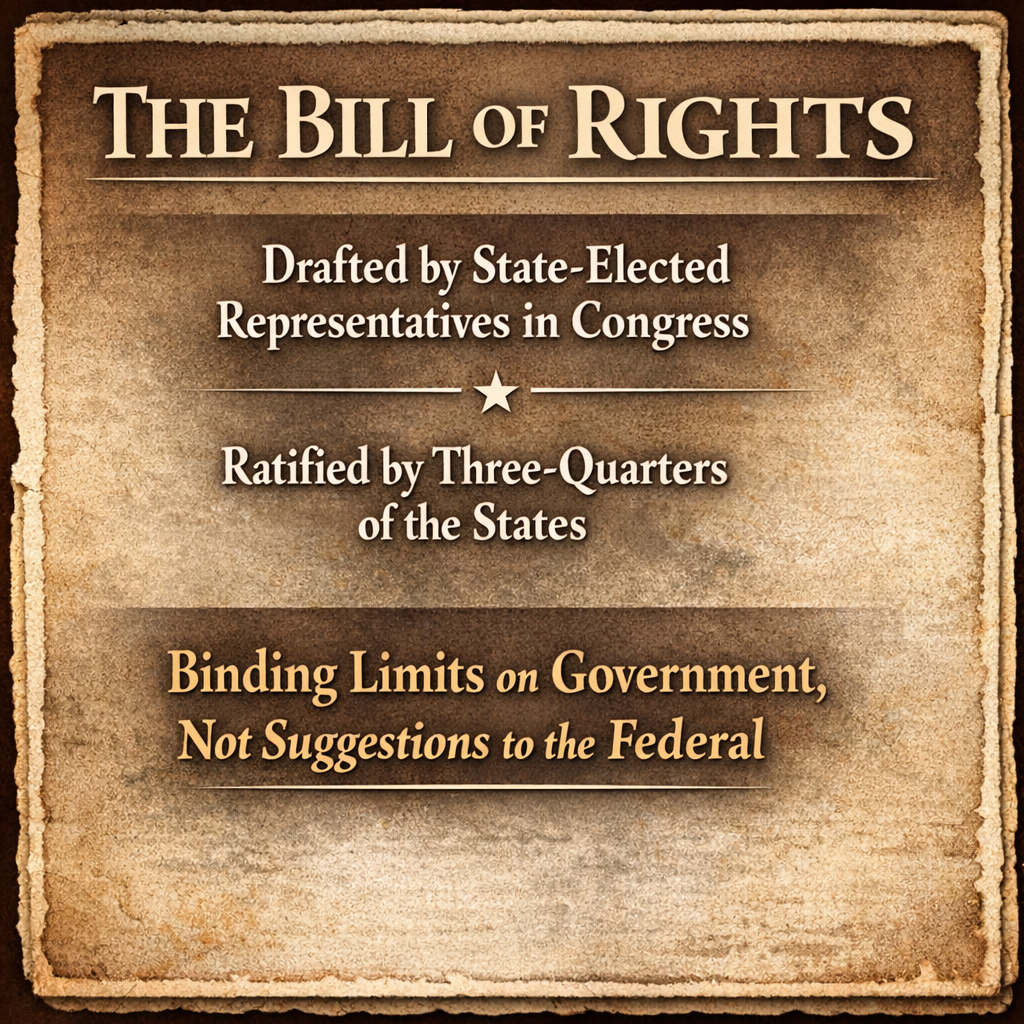
That conclusion is incompatible with the Ninth Amendment, which recognizes that rights preexist enumeration, and with the fundamental principle that constitutions limit government rather than empower courts to invent mechanisms of enforcement. Although the Bill of Rights was proposed by Congress, its provisions were drafted by representatives elected from the several states and acquired legal force only through ratification by three-quarters of the states. If these rights preexisted enumeration, then their ratification reflects the states’ acceptance of their specificity and function as binding constitutional limits, not abstract principles awaiting later judicial redistribution.
Conclusion
Barron v. Baltimore cannot be reconciled with the Supremacy Clause, the structure of the Bill of Rights, or the logic of constitutional amendment. The justifications offered for it are inconsistent and self-defeating.
Gitlow v. New York did not correct Barron; it merely obscured its failure by introducing a doctrinal fiction that allows courts to selectively apply rights without ever explaining why the original holding was wrong.
If the Bill of Rights is part of “This Constitution,” then it has always been a supreme law binding on the states. If it is not, then neither Barron nor Gitlow can be coherently defended.
The problem is not federalism.
The problem is pretending that a constitution can mean one thing in 1791, another in 1833, and something else again in 1925—without ever being amended or having those decisions explained except by mention of “assumptions”.