
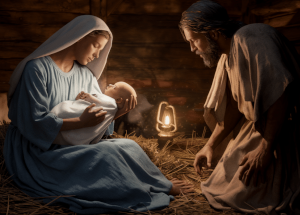
The Virgin Birth?
As with the other articles I’ve written on the Bible, I will rely solely on the Bible to make my points. I am not interested in others’ opinions on the matter, as God supposedly provided me with this book, and I want to rely solely on it for my answers. Before we begin, however, I want to say a brief word on something that very few people acknowledge about most of the books that we read, especially the Bible. Anything written in a foreign language must first be translated before it can be digested by another group of people speaking a different language. The act of performing this translation is daunting to say the least. Not only do you have to choose different words, but you have to understand the context in which the words were spoken to ensure you choose the correct group of words in the next language. To illustrate these types of translation errors, we will examine a word Matthew used in a Greek translation and what scholars know about the original Hebrew word.
Isaiah 7:14, in the original Hebrew, uses the word almah (עַלְמָה), which scholars agree means “a young woman of marriageable age.” However, when the Hebrew scholars of the time translated the Old Testament into Greek (the Septuagint, a couple of centuries before Jesus), they chose the word parthenos (παρθένος), which more strongly suggests “virgin.” As we progress, you will see that this doesn’t really change our main point in this post, but it is worth mentioning, since it explains Matthew’s use later on. By the way, the more appropriate term in Hebrew for a virgin was betulah (בְּתוּלָה).
At this point, because of the error, we know that Matthew was not reading the original Hebrew but a Greek translation. These types of errors occur in many places during translation and are one of the reasons we have so many versions of the same Bible in English. If the job were that simple, you’d only have one version to read and understand. Another example can be seen in the King James Bible, which was written in more archaic English, and the New International Version, which uses more contemporary vocabulary. One may claim these are insignificant tweaks, but as we’ve just shown, some can be quite devastating to an overarching storyline.
Most, if not all, scholars believe that Matthew used the Gospel of Mark as a starting point and expanded on some of Mark’s ideas in writing his own Gospel. I only point this out because Mark failed to mention anything whatsoever about any virgin birth. In fact, Mark starts his entire storyline with Jesus as an adult. He spends no time trying to prove to anyone that Jesus fulfilled any Old Testament prophecies. Could whoever wrote Matthew have been trying to make Jesus more relevant by describing all his fulfillments of prophecy? He already knew what those prophecies were; all he needed to do was write a story of fulfillment that lined up with them. In addition, in his quest to do this, could he have chosen the wrong prophecies and written a story that contradicted what was actually said?
Let’s take a look at the specific language of Isaiah 7:14: “Therefore the Lord himself shall give you a sign; Behold, a virgin shall conceive, and bear a son, and shall call his name Immanuel.”
Taken at face value, it is easy to see why Matthew might have grabbed this text to include in his story, but, like everything in life, you must understand the context before you can lay claim to the understanding. So, let’s back up a few verses and see what was actually happening in this story. Isaiah 7:1: “And it came to pass in the days of Ahaz the son of Jotham, the son of Uzziah, king of Judah, that Rezin the king of Syria, and Pekah the son of Remaliah, king of Israel, went up toward Jerusalem to war against it, but could not prevail against it.”
So, there are two kings plotting against Ahaz, and he is afraid. Then, in Isaiah 7:7, it is said: “Thus says the Lord GOD, It shall not stand, neither shall it come to pass.“
We now reach the original quote Matthew used, and we can see that this prophecy was specifically for Ahaz about the two kingdoms plotting against him. Let’s see what else there is to support it. Isaiah 7:15-16: “15 Butter and honey shall he eat, that he may know to refuse the evil, and choose the good. 16 For before the child shall know to refuse the evil, and choose the good, the land that you abhor shall be forsaken of both her kings.“
This prophecy is clearly about Ahaz and his fear of the two kingdoms plotting against him. It says that within the next few years, both kings will be destroyed and that he should not worry. It uses a young woman who will have a child, whom she will call Immanuel, and that before the child knows the difference between right and wrong, it will be done. Notably, nowhere in the New Testament is Jesus referred to as Immanuel; this term appears only in Matthew’s quotation. Matthew 1:23: “Behold, a virgin shall be with child, and shall bring forth a son, and they shall call his name Emmanuel, which being interpreted is, God with us.”
That is the only place this word appears, but as you can see, Matthew made a mistake and claimed a prophecy that had nothing to do with Jesus. This mistake necessitated explaining why Joseph married her anyway and introduced odd explanations in Matthew and Luke, the only ones treading down this slope. Another problem with the two narratives is the numerous contradictions between the storylines, which we will not explore in this post.
I do want to note that it is not my objective to disprove the Christian narrative; I am only seeking the truth. The most absolute of truths is that no man can be trusted because they are all out to benefit themselves. Without knowing the person and his beliefs and ambitions, it is impossible to judge whether he was telling the truth. Because the Bible was written, organized, and interpreted by men, each with their own personal agendas, it requires an objective search for truth rather than blind faith in humanity.